
What VINELink Covers in Robertson County
VINE means Victim Information and Notification Everyday. Kentucky describes it as a statewide service covering people housed in local jails and adult correctional facilities, with some juvenile coverage. For someone still confined, VINE provides the jail or institution address and telephone. For someone reported out of custody, it provides a release date.
That coverage can bridge Bourbon County Regional Jail, which hosts Robertson detainees, and the Kentucky Department of Corrections. It does not cover every custody system. A federal case requires the BOP Inmate Locator, and immigration detention requires the ICE locator or Detention Reporting and Information Line.
VINE reports custody data supplied by participating agencies. It does not decide guilt, explain a court disposition, or state every term of parole or probation.
How to Check a Specific Inmate on VINELink
Begin at the official service and use an identifier when available. Partial-name searching can find spelling variations, but it also creates namesake risk.
- Open VINELink and select Kentucky.
- Choose “Find an Offender.”
- Enter a partial name or the jail or KDOC offender identifier.
- Compare identifiers and open the correct person record.
- Read the exact custody status, facility, and release information.
- If a local-jail record and KDOC record both appear, inspect both.
- Verify a release with BCRJ, KOOL or Daily Releases, and the Robertson court record.
The Robertson County release-record search provides that broader verification ladder. A missing VINE match alone does not establish release.
What VINELink Shows About a Release
The display varies by record and source agency. Transcribe its labels. Do not turn “not in custody” into “free of all custody,” since another agency may hold the person.
| Field | What it can show |
|---|---|
| Name and identifier | Identity details used to separate similar names |
| Custody status | Whether the supplying jail or correctional agency reports confinement |
| Facility information | Current jail or institution address and phone for a confined person |
| Release date | The reported date for a person no longer in that agency's custody |
| Notification option | A route to register for future status changes |
A live roster is different. It is built to show people now housed at that jail, so a released person may disappear. A VINE released result is stronger than roster absence because it supplies an event and date.
How to Register for a Robertson County Release Notification
Registration attaches a notification method to the correct person record. Kentucky permits multiple phone numbers or email addresses. If two records exist, register on both so a move from the local host jail into KDOC does not create a gap.
- Select “Notify Me of Status Changes” from the correct result.
- Follow the prompts for telephone and/or email.
- Create a four-digit PIN for telephone alerts.
- Enter that PIN when VINE calls to acknowledge the notice.
- Keep the PIN private and available to the registrant.
- Call 800-511-1670 for telephone registration or help.
Kentucky says jail-release calls repeat every 30 minutes for up to 24 hours or until acknowledged. Scheduled state-institution notice may be attempted 72 hours before release. Immediate credit changes, a court discharge, parole, or escape can cause notice only when the event occurs. Calls may arrive at any hour.
VINELink Limits and How to Confirm a Release
VINE depends on booking and corrections feeds. A delay can occur between a legal order, physical processing, agency data entry, and vendor transmission. The service also cannot establish that no other county, state, federal, or immigration hold exists.
A release notice also does not explain supervision. KOOL, the court order, District 14, or a final Parole Board record is needed to distinguish parole, probation, mandatory reentry supervision, and complete discharge.
Robertson VINELink Dual Records
KDOC warns that one person can have both a local-jail record and a DOC record. That detail matters in Robertson County because the local detention path already crosses county lines: Robertson's elected offices and court are in Mount Olivet, while BCRJ in Paris operates the host jail.
Registering only on the local entry may miss later state movement. Registering only on the KDOC entry may miss the earlier BCRJ event. Compare identifiers, examine both entries, and set notifications on both when they are clearly the same person.
Note: A transfer is continued custody, not community release, even if the person disappears from the BCRJ current-inmate portal.
Robertson Release Alerts Need Confirmation
KDOC documented vendor-caused false release alerts on February 3, 2026 and published corrected release information. That Kentucky event shows why an automated notice should begin a records check rather than end it.
For a BCRJ record, call the host facility and compare the Robertson court order when the reason for release matters. For a state record, check KOOL and the dated Daily Releases archive. Those sources help distinguish release from a mistaken transmission, transfer, or another custody event.
The official Kentucky VINE information page carries service notices. It is the right place to check for a known system issue.
Robertson VINELink Search Screen
The official VINELink search begins with state selection and a person-specific offender search.
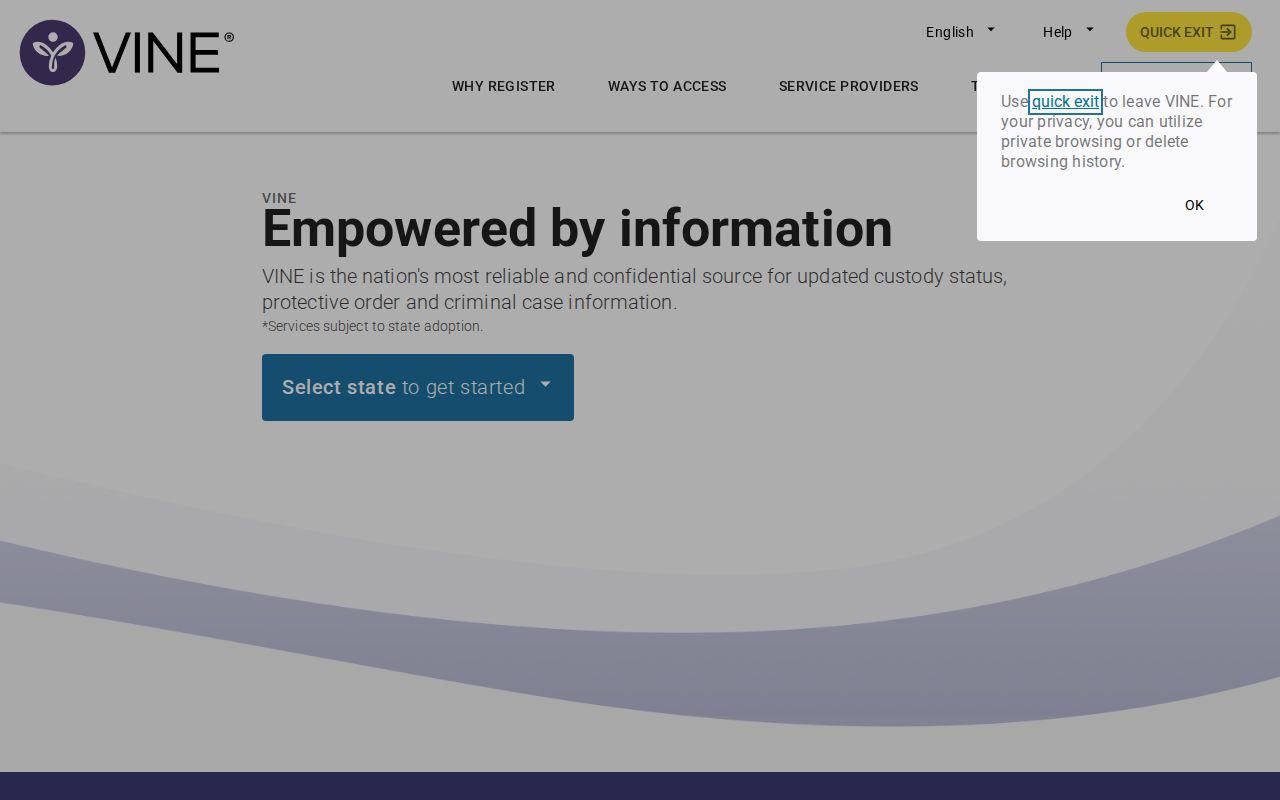
The screen is a starting point. Select Kentucky, match the correct record, and use the agency checks above before treating a status change as final.
Read Robertson VINE Release Status
“Not in custody” is tied to the record and agency feeding VINE. It is stronger than mere absence from a roster because Kentucky says the record supplies a release date, but it does not prove that every form of custody has ended. A BCRJ release could be followed by KDOC placement, another county hold, federal custody, or immigration detention.
Compare the facility and identifier before reading the event. If the local record changes while a KDOC record remains active, the likely issue is movement between systems rather than full release. Verify the exact event with the BCRJ transport or release record and KOOL. Kentucky's Daily Releases archive is useful for state-managed cases because its dated PDFs identify the person, release type, released-from facility, and highest felony class.
Release types should remain exact. “Discharged - Minimum Expiration,” “Mandatory Reentry Supervision - In State,” and “Shock Probation Began - In State” describe different legal outcomes. A VINE date alone may not supply that distinction. The KDOC release document or court order does.
A court order can authorize release before jail processing is complete. VINE may receive the event after the booking system transmits it. For that reason, do not compare timestamps as though each source records the same moment.
Cross-Check Robertson Release Alerts
For a local Robertson case, contact BCRJ at 101 Legion Drive in Paris, 859-987-2137. Ask whether the person was processed out, transferred, or remains under another hold. The Robertson Circuit Court Clerk at 127 East Walnut Street in Mt. Olivet can provide the order that explains bond, dismissal, probation, sentence, or another legal basis.
For state custody, KOOL is the first identity and status check. Then use KDOC Daily Releases for the actual event and exact release type. A future eligibility or expiration field is not an exit. If parole is involved, the final Board action must be distinguished from an eligibility list or scheduled hearing.
Federal and immigration systems sit outside VINE's Kentucky jail and adult-corrections coverage. BOP explains that a past release date with no facility, or a location of “RELEASED,” means the person is no longer in BOP custody. ICE uses its own detainee locator and help line. Neither source proves the status of a separate Kentucky case.
The safest conclusion is narrow: name the agency, record, status, and retrieval date. State what that source proves, then note any separate custody system that still needs a check.
Robertson VINE Notification Details
The inmate is not told who registered for a VINE alert. The four-digit PIN belongs to the registrant and acknowledges a telephone call; it is not an offender identifier. A phone system that cannot accept the PIN is unsuitable because the repeat-call cycle may continue.
Keep contact information current and save the offender identifiers used for registration. When an alert arrives, note which record triggered it. A local jail alert and a KDOC alert can refer to different stages of the same custody history.
VINE information is available around the clock, while direct office verification may depend on agency operations. An overnight alert should still be checked through the official record as soon as practical.
Telephone notice and email notice serve the same core purpose but have different acknowledgment steps. The PIN stops repeated calls after the recipient confirms the message. It does not alter the offender record or tell the agency that a family member will provide transportation. Release logistics must be confirmed separately with the facility.
If contact details change, update the registration instead of assuming the old notice will forward. Kentucky allows several phone numbers and emails, which can reduce a missed notice. Each registrant should understand that an unexpected call can occur at night and that a transfer alert may not mean freedom from custody.
For a Robertson person initially booked at BCRJ, save the local jacket or booking identifier as well as any KDOC number. Those identifiers make it easier to determine which alert fired and to ask the correct agency for the matching event record.
Robertson VINE Versus Registry Records
The Kentucky Sex Offender Registry is not a substitute for VINE. It covers only people who have a statutory registration obligation and provides registry-specific location and alert tools. Absence from it does not prove that someone remains confined, has been released, or lacks a criminal case.
VINE focuses on custody and release notifications from participating correctional systems. The registry focuses on a separate legal duty after release. Use the Kentucky State Police registry only when that duty is relevant, and use VINE, KOOL, BCRJ, and court records for custody verification.